On Tuesday, Indonesian Muslims sacrificed animals to please Allah. In doing so they remembered the story of Abraham from the Quran, who was willing to sacrifice his own son for God, and they remembered God’s kindness for providing a sheep instead.
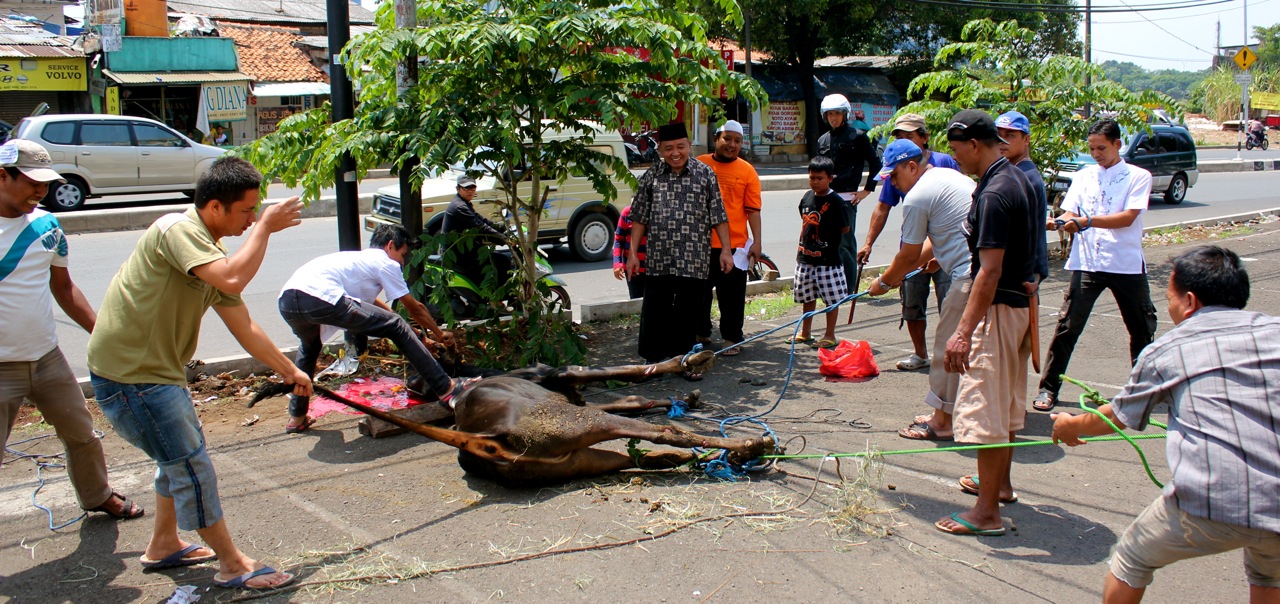
After the animals — goats, sheep and cattle — were slaughtered, most of the meat was distributed to the poor. The national Istiqlal Mosque, in Jakarta, distributed 6,000 one-kilo rations of meat to people in need. This was the holiday Eid ul Adha, which I have explained in previous posts.
Across Jakarta, animals were slaughtered in mosques, on roadsides, and in parking lots. We saw one group of men slaughter a cow in the parking lot of a nearby post office, then roll its carcass onto a tarp and carry it through the post office, to a back patio, to be butchered. Another family lay a slaughtered goat by the roadside presumably so that the blood would drain into the sewer. The animals were slaughtered in accordance with Islamic halal rules, though many were killed by amateurs with crude tools. Kind or cruel, the killings were public, held proudly in the open for all to see.
I hesitated to post photos of Eid-ul-Adha events on this blog. Many of the scenes I captured seemed inappropriate in some way — even for the Internet. On the other hand, passersby on Jakarta streets could not miss these scenes; children of all ages ogled at the bloody sacrifice of animals. Men and boys were clearly proud to participate in the slaughter. So why did photos seem inappropriate?
In the West, we might see pictures of meat hanging in a refrigerated meat locker on the evening news, or perhaps cows in a stockyard in the newspaper. But the in-between, transition phase, when death is confronted and the animal is initialy dismembered, is considered vulgar. I was surprised to find how dramatically Indonesian culture differs from that perspective.
The following is a candid account of my Eid-ul-Adha, in particular of that phase so often omitted from American media.
A small crowd was gathering as I parked in front of the post office. As we approached, I watched a man pull a golok (traditional knife) across a cow’s throat. At least four other men were holding the cow with all their might by the legs and tail as it began to convulse. Its eyes darted in terror. Its spinal cord was still intact, though its windpipe had been severed, and so the cow gasped for air through the round hole in its open neck. A moment later its eyes turned glassy. This was the transition from life to death and the beginning of a shift from animal to meat, cow to beef — a moment rarely witnessed by Westerners.
Then the men read a prayer before slaughtering a goat, which bayed desperately as though the cow’s fate had been an omen to it. The goat’s throat is smaller and less difficult to cut; it died quickly. As a group of men rolled the cow’s lifeless body onto a blue tarp, one man held up the goat’s head like a messy trophy.
At a mosque down the road, the atmosphere was more festive. A man distributed slices of watermelon to children and other onlookers. With 28 dead animals in the parking lot, the men here needed a quick division of labor. Some emptied the entrails into the sewer in the corner. With their heads now removed, the two cows had lost the aura of animals. A small boy sat on one headless carcass, resting in the Jakarta sun. The other carcass was being dissected. Men wandered around with blood from their fingernails to their elbows, sharpening knives on square blocks. Some listened in as the lead butcher gave further instructions. Four men struggled to carry the intestines across the parking lot, trying not to let them drag on the ground. With the organs removed, as the men peeled back its hide, the carcass transformed into a side of beef. The children seemed excited about which pieces they would take home to eat. The most experienced butcher turned around with the cow’s penis in his hands to give a quick anatomy lesson for the giggling boys and girls. The atmosphere was that of macabre Fourth of July Picnic. The Imam (church leader) looked pleased, watching quietly from near the mosque door.
Throughout the day I saw people walking along the streets with newspaper-wrapped packages, or plastic grocery bags, bloody with their ration of meat.
The slaughter and distribution of meat will continue for the rest of the week. Some of those who receive free rations will sell them for a few dollars, choosing vegetarianism out of necessity.


 Adventures for the whole family
Leave a comment