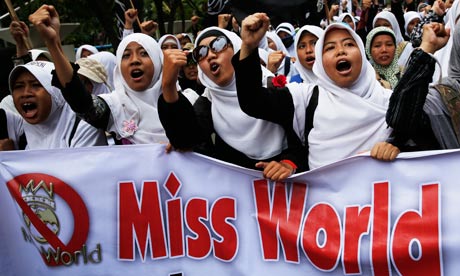
Jakarta is no stranger to major international events and concerts, such as a recent Metallica concert and the Mixed Martial Arts (cage fighting) world championship. But many events planned for Jakarta are canceled on short notice for vague reasons; some recent victims have been Lady Gaga, Kesha, and now, the Miss World pageant.
Both Lady Gaga and the Miss World Pageant drew large crowds of protesters to Jakarta’s streets. According to the BBC, police in Indonesia had refused to issue a permit for Lady Gaga last year after Islamic groups objected to her show, claiming it was too vulgar. Her management decided to eliminate the Jakarta stop from her tour. The Miss World Pageant events in Jakarta were canceled by the Vice President of Indonesia himself, in response to protests from radical extremists, according to The New York Times. Critics worry that the pageant is “yet another example of authorities bowing to religious extremists.” (The pageant was relocated to the island of Bali, a popular tourist destination just east of Java that is home to a Hindu majority and is more accustomed to scantily clad foreigners.)
On one hand, it is refreshing to see Indonesians protesting the government, which so often ignores their best interest. But I agree with Bloomberg columnist William Pesek when he calls this public anger misplaced. Why not protest the cities’ lack of public services and infrastructure instead?
Beauty pageants and Lady Gaga’s “Born This Way” tour send very different messages. One suggests that women are primarily valued for their appearance. The other outwardly supports the rights of gay, lesbians and bisexuals. What these events have in common are scantily clad women, setting off alarm bells for conservative Muslim organizations. In contrast, an event featuring nearly naked men savagely beating each other in a cage drew no such protests.
A variety of Islamic fundamentalist groups organize these protests. Some are dangerous and violent, such as the Islamic Defenders Front (which I wrote about in July), a group that operates more like thugs than moral idealists, motivating with fear and greed instead of painstakingly building a movement.
Others are non-violent Muslims such as the national counsel of clerics, and Hizb ut-Tahrir, an international organization that seeks a global unified Islamic state. Though the majority of Indonesia’s 200 million Muslims are moderate, these groups are potential leaders for grass-roots social activism. In the U.S., leaders like Martin Luther King and Saul Alinsky led social activism for positive political change out of churches, because those were the centers of civil society. In Indonesia, mosques serve that role and are proving their ability to build social movements. It is sad that that power is directed only at the occasional target of moral offense, rather than at the broader social and political ills of this country.
Instead, Indonesia continues to attract international attention for canceling events because the government caves to religious extremists. This only perpetuates a Western fear of Islam.


 Adventures for the whole family
Leave a comment